7 Simple Principles of Healthy Living for a Balanced Life (2026)
- TheCareReview Staff
- Mar 6
- 9 min read

This post contains affiliate links. If you purchase through our links, we may earn a small commission at no extra cost to you. Our recommendations are based on research and genuine usefulness, not who pays the most.
You already know something's off.
Maybe it's the 3 PM energy crash that hits like clockwork. The sleep that never feels quite deep enough. The nagging tension in your neck has basically become your personality at this point. 😅
Here's the thing: most of us aren't unhealthy because we lack willpower. We're just missing a clear, practical framework that actually fits real life.
And that's exactly what this is.
Not a 90-day challenge. Not a complete diet overhaul. Just 7 simple principles, backed by research and built for real people, that when stacked together, genuinely shift how you feel day to day.
Let's get into it. 👇

Quick Verdict: Which Principles Matter Most for You?
If you're dealing with... | Start here |
Low energy, brain fog | Principle 1: Nourish Your Body |
Feeling stiff, out of shape | Principle 2: Stay Active |
Restless nights, poor sleep | Principle 3: Sleep Enough |
Stress, anxious thoughts | Principle 4: Stay Positive |
Afternoon slumps, headaches | Principle 5: Stay Hydrated |
Chronic tension, burnout | Principle 6: Manage Your Stress Actively |
Feeling isolated or low | Principle 7: Build Real Connections |
Principle 1: Nourish Your Body 🥗
Food is not just fuel. It's information.

Every meal you eat sends signals to your cells, telling them to repair, energize, or inflame. Ultra-processed foods, which make up roughly 60% of the average person's daily energy intake, have been linked to more than 30 health conditions, including heart disease, type 2 diabetes, and mental health issues like depression and anxiety. National Geographic
That's not meant to scare you. It's meant to show you how much power you actually have here.
The goal isn't perfection. It's making slightly better choices most of the time.
Start with these basics:
Eat at least 5 portions of fruits and vegetables daily.
Prioritize whole foods: grains, legumes, nuts, lean proteins.
Swap one ultra-processed item a day for something real. Just one. Build from there.
Now, in a perfect world, we'd get every nutrient from food. But realistically? Most people don't. 🙃
That's where a solid daily multivitamin can genuinely help. Not as a replacement for good food, but as a reliable backup for the gaps.
MuscleBlaze MB-Vite Daily Multivitamin is one of the more comprehensive options out there, packing 51 ingredients across 6 blends, covering vitamins, minerals, probiotics, prebiotics, and amino acids in one tablet.
It's earned over 17,000 reviews on Amazon with a solid 4.2-star rating, and 2,000+ people buy it every month, which tells you something. It sits comfortably in the budget-to-mid-range category, so it's easy to stay consistent without it feeling like a luxury.
If you're not already on a multivitamin, this is a straightforward place to start.
Principle 2: Stay Active 🏃
You don't need a gym membership to live an active life.

Being active, defined as briskly walking at least 150 minutes per week, is associated with living an extra 4.5 years. That's not from some obscure study. That's a consistent finding across multiple major datasets.
And here's the part people miss: it's not just cardio. Lifting weights or doing resistance training helps stave off bone loss, preserve muscle, improve balance, lower inflammation, and reduce joint pain.
You need both. Not to look a certain way, but to function well as you age.
Easy ways to build more movement into your day:
Take the stairs whenever possible.
Walk during phone calls.
Do 10 minutes of bodyweight exercises before bed.
Dance. Genuinely. It counts. 💃
One thing people underestimate is recovery. Pushing your body without giving it time to repair is how injuries happen, and how people fall off routines entirely.
That's where the CARESMITH Charge Go Massage Gun earns its place. It comes with 4 specialized heads for targeting different muscle groups, back, legs, and full body, and it's the #1 bestseller in Electric Handheld Massagers on Amazon, with over 2,500 reviews averaging 4.2 stars.
Over 8,000 people bought it last month alone. That's not a coincidence. It's a genuinely solid, budget-friendly recovery tool.
Post-workout soreness is normal. Letting it derail your consistency isn't. A few minutes with a massage gun after a workout makes a real difference in how you feel the next day.
Principle 3: Sleep Enough 😴
If you're sleeping 5-6 hours and feeling "fine," you're probably not fine.

Poor sleep quality shortens lifespan by increasing the risk of chronic illness like heart disease, obesity, and cognitive decline. Innovativefitness Your brain literally uses sleep to clear metabolic waste products, the kind that, when left to accumulate, are associated with Alzheimer's disease.
The target is 7-9 hours, and quality matters just as much as quantity.
What actually helps? More than you'd think:
A consistent sleep schedule: same time every night, even weekends.
Keeping your room cool and dark.
No screens for 30-60 minutes before bed.
And potentially, magnesium.
Here's the science. Magnesium acts as a natural NMDA receptor antagonist and GABA-A agonist, which basically means it helps quiet neural excitability and promote relaxation at the biological level.
A 2025 randomized controlled trial found that magnesium bisglycinate supplementation resulted in significantly greater reductions in insomnia severity scores compared to placebo, with improvements occurring within the first 14 days.
Nearly 50% of adults may not get enough magnesium through diet alone, Sleep Foundation making supplementation genuinely useful for a large chunk of the population.
The Carbamide Forte Chelated Magnesium Glycinate is a strong pick here. It's the #1 bestseller in Magnesium on Amazon, with over 8,300 reviews and a 4.2-star rating. 10,000+ people buy it every month. That's not marketing hype. That's a pattern worth paying attention to.
Chelated magnesium glycinate is specifically the form most studies point to for sleep and relaxation benefits. It's gentler on the stomach and better absorbed than cheaper magnesium oxide formulas.
And if neck or shoulder tension is keeping you up at night 👀, the Heycool Cordless Neck Massager is also worth a look.
It uses 4D shiatsu kneading with heat to target deep muscle tension in the neck and shoulders. It's cordless, so you can use it on the couch, in bed, or wherever you actually wind down. It carries 348 reviews at 4.1 stars, with users frequently noting how much it helps them relax before sleep.
Principle 4: Stay Positive 🌱
"Stay positive" sounds like something printed on a coffee mug. But there's real science here.
Research from 2023 found that happy people live longer, largely because they tend to maintain healthier behaviors overall. Optimism isn't fluffy. It's functional.
Positivity isn't about ignoring hard things. It's about building mental habits that make hard things feel more manageable.
Practical ways to cultivate it:
Start a 3-line gratitude log each morning. Just 3 things.
Spend time outside. Even 10 minutes of sunlight meaningfully shifts mood.
Reduce doomscrolling. Yes, actually.
Create calming rituals that signal to your brain that you're safe and at ease.
One thing that's quietly effective? Aromatherapy. 🌿

It's not pseudoscience. Scent directly stimulates the olfactory bulb, which connects to the brain's limbic system (the emotional processing center). Lavender and eucalyptus in particular have been studied for their calming effects on the nervous system.
The ASAKUKI 500ml Essential Oil Diffuser is a beautifully designed, 5-in-1 ultrasonic aromatherapy diffuser. It humidifies, diffuses, has timer settings, and an auto-off safety switch. It holds 500ml so it runs for hours without needing a refill.
It's an Amazon's Choice product with over 40,000 reviews at 4.0 stars. That review count is remarkable. It means a massive, diverse base of people have tested it and kept coming back.
It's also genuinely affordable for what it does. A calming evening environment is one of the most underrated wellness investments you can make.
Principle 5: Stay Hydrated 💧
This one sounds obvious. And yet, most people are mildly dehydrated most of the time.
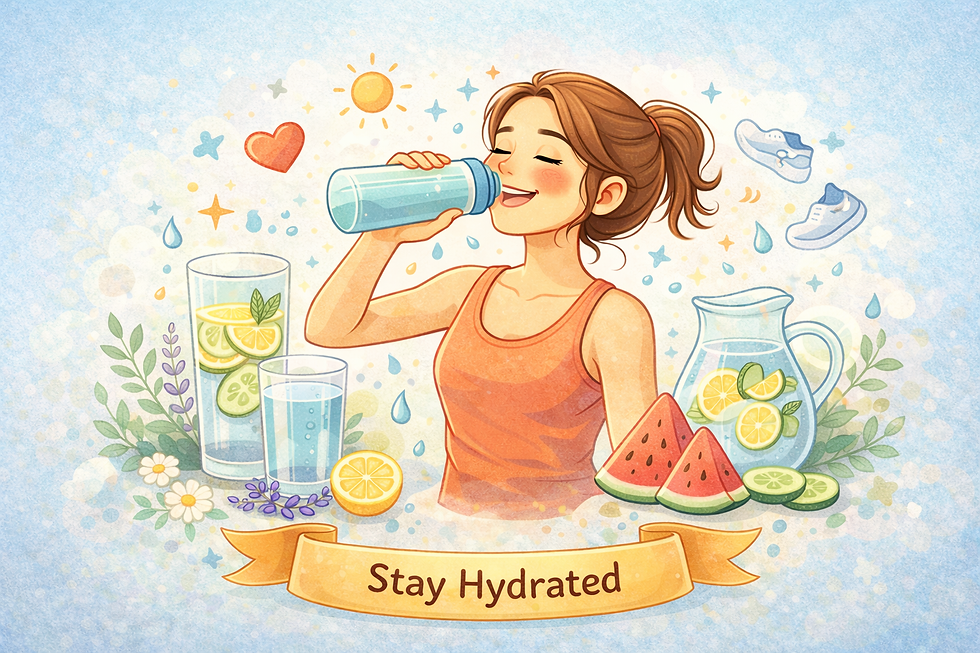
Your body is roughly 60% water. Every system in it, from digestion to cognition to circulation to joint lubrication, depends on adequate hydration to function properly.
Dehydration by just 1-2% has been shown to impair focus and mood. That afternoon slump you blame on not enough sleep? Half the time, it's not enough water.
Simple habits that actually stick:
Start every morning with a full glass of water before coffee.
Keep a water bottle on your desk. Visibility is half the battle.
Eat water-rich foods: cucumber, watermelon, leafy greens, oranges.
If plain water bores you, add lemon, mint, or a slice of cucumber.
A useful rough guideline: aim for 8-10 cups a day (around 2-2.5 litres) as a baseline, and more if you're exercising or in a warm climate.
Principle 6: Manage Your Stress Actively 🧘
Stress is not just a feeling. It's a physiological state with measurable consequences.

A 2024 review found that regularly experiencing stress and anxiety can increase the chance of developing heart disease, and the effects are more pronounced in women.
Chronic stress keeps cortisol elevated, disrupts sleep, triggers inflammation, suppresses the immune system, and contributes to weight gain. It's not dramatic to say that unmanaged stress is one of the biggest health risks in modern life.
The keyword is actively. Hoping stress will resolve itself isn't a strategy.
What actually works:
Breathwork. Box breathing (inhale 4 counts, hold 4, exhale 4, hold 4) can shift your nervous system from fight-or-flight to rest-and-digest within minutes. Try it the next time you feel your jaw clench.
Movement. Even a 20-minute walk significantly reduces cortisol levels.
Journaling. Getting the noise out of your head and onto paper genuinely reduces rumination.
Creating sensory calm. This is where aromatherapy, low lighting, and even a warm shower with intentional breathing do real work.
The ASAKUKI diffuser mentioned in Principle 4 pulls double duty here. Setting up a dedicated wind-down ritual in the evenings signals to your nervous system that it's time to come off high alert. Small habits like this compound over time. 🌙
Principle 7: Build Real Connections 🤝
This is the one most wellness content skips. And it's arguably the most important.
Research shows that maintaining healthy social networks helps improve longevity and leads to better health outcomes, and a strong social circle may help you react less negatively to stress.
A large body of research shows that social isolation and loneliness have a serious impact on physical and mental health, quality of life, and longevity.

This isn't about having hundreds of acquaintances. It's about depth.
A few meaningful relationships, people who actually know you and show up, do more for your health than a packed social calendar of surface-level interactions ever could.
How to build and maintain genuine connection:
Schedule regular catch-ups with people who matter. Put it in your calendar like a meeting.
Be the one who checks in first. Don't wait.
Put your phone away when you're with people. Fully present beats half there every time.
Volunteer or join community activities. Connection through shared purpose is especially powerful.
And if you're going through a hard stretch, reach out. Asking for support is not a weakness. It's one of the healthiest things you can do.
What to Look for When Building Your Healthy Living Toolkit
A few principles to guide your choices before spending anything:
Consistency over intensity. The best habits are the ones you can maintain for years, not the ones that sound impressive for a week.
Basics before upgrades. Sleep, hydration, movement, and real food do more than any supplement stack. Build the foundation first.
Bioavailability matters in supplements. Not all forms of a supplement are equal. Chelated magnesium glycinate absorbs better than oxide. Multivitamins with diverse blend coverage outperform basic formulas. Read labels.
Recovery is training. Whether it's a massage gun, a neck massager, a magnesium supplement, or just a proper wind-down routine, recovery is not optional. It's where adaptation happens.
Frequently Asked Questions ❓
Q: Where should I start if I'm completely new to this?
Start with sleep and hydration. They're free, require no equipment, and underpin everything else. Once those are dialled in, layer in movement and nutrition. Think of it as building a house: foundation first.
Q: Do I actually need supplements if I eat well?
Most people have at least one or two nutritional gaps, even with a good diet. Magnesium is commonly under-consumed even in balanced diets, and a basic multivitamin is a simple, low-cost safety net for micronutrient gaps.
Q: How long before I notice results from lifestyle changes?
Hydration improvements can shift how you feel within days. Sleep quality changes from magnesium supplementation can show up within 1-2 weeks. Energy, mood, and physical changes from consistent exercise and nutrition typically become noticeable after 4-8 weeks.
Q: Is 7 hours of sleep really enough, or do I need 8?
It varies by individual. The research-backed range is 7-9 hours for most adults. If you're waking up tired consistently, the quantity or quality of your sleep needs attention, and both are worth addressing separately.
Q: Can stress really cause physical health problems?
Yes, and this is well-established. Chronic elevated cortisol has documented links to heart disease, immune suppression, weight gain, and cognitive decline. Managing stress isn't a soft skill. It's a hard health requirement.
Q: Do I need to do all 7 principles at once?
Absolutely not. Pick one or two that feel most relevant right now and build from there. Small, consistent changes stack up faster than you'd expect.
Final Verdict
There's no single habit that fixes everything. That's both the honest truth and, actually, the good news.
Because it means you don't have to overhaul your entire life overnight. You just have to start somewhere and keep going.
If you're dealing with energy issues, start with nutrition and a multivitamin. If sleep is the problem, try magnesium glycinate and build a proper wind-down ritual. If tension and stress are the main issue, movement and active recovery tools like a massage gun or neck massager make a real difference.
Good health is cumulative. The best version of your lifestyle is one you can actually maintain, night after night, week after week.
Explore the products mentioned in this article on Amazon to find the right fit for where you're starting.


Comments