5 Sunscreens That Are Actually Worth It in 2026 ☀️
- TheCareReview Staff
- Mar 4
- 12 min read

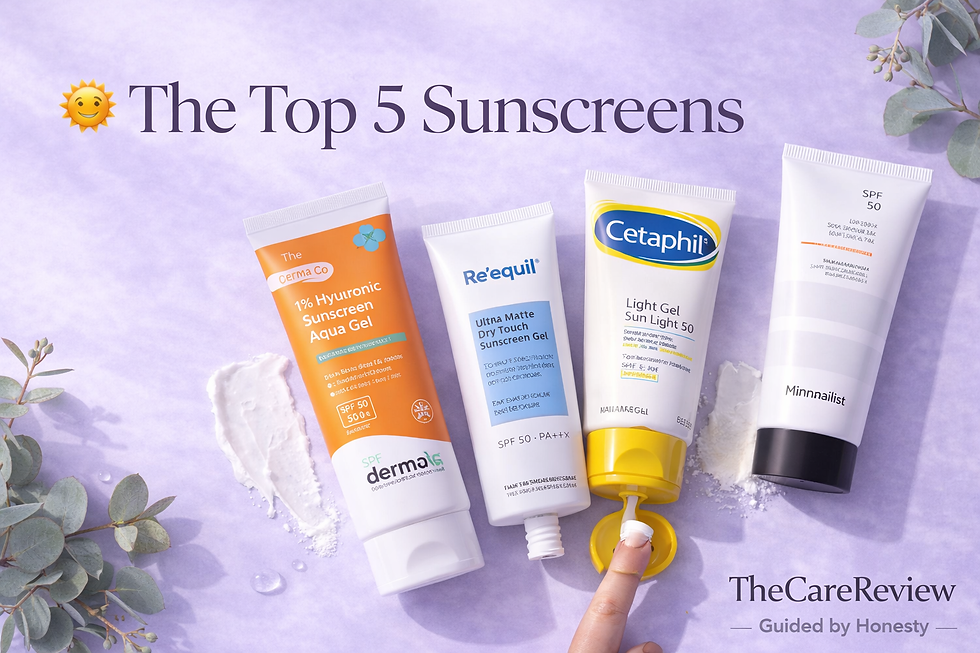
Let’s be honest: most of us know we should wear sunscreen every day. But between the white cast, the greasy finish, and the way some formulas just sit on your face like a layer of sadness - it’s easy to skip it. Sound familiar? You’re not alone.
Here’s the thing, though. The best sunscreen isn’t the most expensive one or the one with the longest ingredient list. It’s the one you’ll actually reach for every morning without dreading it. And finding that one? That’s exactly what this review is for.
Daily UV exposure is the single biggest external cause of premature aging, dark spots, and uneven skin tone. All the serums and moisturisers in the world can’t undo what skipping SPF does over months and years. The good news is that sunscreen has come a long way: the five picks below are lightweight, genuinely effective, and comfortable enough to wear daily without any drama.
We’ve looked at ingredient quality, texture, real-world user feedback, and value - so you don’t have to wade through a hundred options yourself. Whether your skin is oily, sensitive, dry, or somewhere in between, there’s a match for you here.
🏆 Our Top Picks at a Glance
Here is a table template with 6 rows and 3 columns as requested:
Sunscreen | Skin Type | Why We Love It |
Beauty of Joseon Relief Sun | All skin types | Featherlight feel, no white cast, skincare benefits built in |
💰 Best Budget The Derma Co Hyaluronic Aqua Gel | Normal to oily skin | Genuinely affordable with real hydration — no compromises |
🥖 Best for Oily Skin RE’EQUIL Ultra Matte Dry Touch | Oily / acne-prone skin | Mineral-based, actually matte all day, sweat-resistant |
🌿 Best for Sensitive Skin Cetaphil Sun SPF 50 Light Gel | Sensitive / reactive skin | Dermatologist-trusted brand, gentle formula, holds up to sweat |
📦 Best Value Minimalist Sunscreen SPF 50 PA++++ | All skin types | Largest quantity, niacinamide included, clinically tested |
☀️ The Full Reviews
1. Beauty of Joseon Relief Sun: Rice + Probiotics SPF 50+ PA++++

If you’ve ever put on a sunscreen and immediately wished you hadn’t — this is the antidote. The Beauty of Joseon Relief Sun has earned its cult status honestly. It goes on like a serum, sinks in within seconds, and leaves absolutely nothing behind. No film, no shine, no greyish cast. Just protected skin that looks like skin.
The Rice Bran Extract isn’t just a pretty label claim. It’s packed with ferulic acid and gamma-oryzanol — antioxidants that mop up the free radicals that UV light generates. Think of it as a secondary line of defence working alongside the SPF filters. Over time, consistent use also helps with the kind of subtle dullness that builds up from daily sun exposure. It’s a slow and quiet brightening, but it’s real.
The Lactobacillus Ferment (the probiotic component) helps maintain your skin’s microbiome — the community of good bacteria that keeps the skin barrier stable and calm. If your skin tends toward redness or reactivity, a healthier barrier means less of that. It’s a thoughtful addition that turns a great sunscreen into something that genuinely cares for your skin beyond UV protection.
The texture is almost serum-like — light and fluid — and it blends so easily that it feels effortless even on rushed mornings. Users consistently describe it as “the first sunscreen I actually enjoy putting on,” and honestly, that says everything. Makeup sits on top of it beautifully, no pilling, no sliding.
The one genuine trade-off is price. This isn’t the budget pick — and at 50ml, a tube used properly (enough product, reapplied midday) won’t last as long as you might hope. But for those who can stretch to it, this is the closest thing we’ve found to a perfect everyday sunscreen.
You’ll love it if: You want SPF that feels like nothing, works with makeup, and quietly improves your skin over time. Not the right fit if you’re fragrance-sensitive or need heavy-duty oil control.
2. The Derma Co 1% Hyaluronic Sunscreen Aqua Gel SPF 50 PA++++

There’s a version of “affordable” that feels like a compromise — thinner formulas, vague ingredient lists, a sense that you’re getting less than you paid for. This isn’t that. The Derma Co Hyaluronic Aqua Gel is genuinely one of the best-value sunscreens we’ve come across, and 35,000+ user reviews back that up more convincingly than we ever could.
The hero ingredient is Hyaluronic Acid at 1% — a humectant that holds up to 1,000 times its own weight in water. That sounds like marketing speak until you feel the difference: this SPF hydrates while it protects, so you don’t come away from application feeling tighter or drier than before. One tip: apply it on slightly damp skin. This lets the HA draw in moisture from the surface rather than anywhere it shouldn’t.
Vitamin E adds an antioxidant layer alongside the UV filters, helping neutralise the free radicals that slip through. It also contributes to the smooth, comfortable feel without adding any heaviness.
The aqua-gel formula is something else. It spreads like cool water, absorbs in under 30 seconds, and leaves nothing behind — no stickiness, no residue, no “I just put sunscreen on” feeling. It layers cleanly under makeup, though a tip: let your moisturiser fully absorb first or you may get some minor pilling under foundation.
You’ll love it if: You want excellent sun protection without spending a lot, and your skin runs normal to oily. For very dry skin types, this is still a great choice — just add a hydrating serum underneath on drier days.
3. RE’EQUIL Ultra Matte Dry Touch Sunscreen SPF 50 PA++++

Here’s the thing about “matte” sunscreens: most of them lie. They feel fine for the first hour, then your skin looks glazed by noon. RE’EQUIL’s Ultra Matte Dry Touch is one of the few that actually follows through. Users with oily skin consistently report this one genuinely holds back shine — not just initially, but hours later. That’s rare, and it matters.
The reason it works so well is the Titanium Dioxide UV filter. Unlike chemical filters, which absorb UV and convert it to heat, Titanium Dioxide physically sits on the skin and reflects UV away. It’s one of the most well-tolerated UV filters available, making it a better fit for those whose skin has a history of reacting to chemical sunscreen formulas. If you’ve ever broken out from sunscreen and given up entirely, this one is worth a try.
The dry-touch technology uses silica-based absorbents to create a powdery, silky finish. It holds up through sweat and humidity, which makes it a practically useful choice for active lifestyles or warm, muggy weather.
One thing to be aware of: Titanium Dioxide is a white pigment by nature. On deeper skin tones, it can leave a subtle cast without thorough blending. Give it an extra 30 seconds and that resolves for most people — but it’s worth knowing going in.
You’ll love it if: Oily skin, shine control, outdoor use, or you’ve had past sensitivities to chemical sunscreens. Not the best match for very dry skin or those needing an imperceptible finish on deep complexions.
4. Cetaphil Sun SPF 50 Sunscreen Light Gel

When your skin is reactive, finding a sunscreen that doesn’t cause a problem is the goal. You’re not looking for the most innovative formula — you’re looking for something clean, reliable, and kind. Cetaphil has built its entire reputation on exactly that, and this sunscreen is a natural extension of everything the brand stands for.
Cetaphil is one of the most recommended brands in dermatology for sensitive, reactive, and post-procedure skin — eczema, rosacea, skin recovering from treatments that just needs something uncomplicated. The Sun SPF 50 Light Gel carries that legacy. It’s not trying to do ten things at once; it’s trying to protect your skin, hydrate it gently, and disappear. It does all three.
Vitamin E is the supporting ingredient worth highlighting. It’s a fat-soluble antioxidant that works alongside the UV filters, neutralising the free radicals that make it through the sunscreen barrier. Pairing this SPF with a Vitamin C serum in your morning routine quietly amplifies antioxidant protection further — a combination that’s particularly useful for anyone dealing with redness or pigmentation.
The gel texture is genuinely pleasant — spreads effortlessly, absorbs without drag, and leaves skin looking clean rather than coated. The very water resistant formula holds up through warm weather and physical activity, which matters if your SPF tends to slide off by mid-morning.
One caveat worth noting: this formula does contain fragrance. For most people that’s a non-issue, but if you specifically manage fragrance allergies or contact dermatitis, check the full INCI list before committing.
You’ll love it if: Your skin is sensitive, reactive, or recovering from a treatment and you need something you can trust completely. The price is a step up, but for peace of mind on reactive skin, that’s a fair trade.
5. Minimalist Sunscreen SPF 50 PA++++ with Multi-Vitamins

If you want to get the most out of every dollar you spend on sun protection, this is where to look. Minimalist’s SPF 50 comes in a 100g tube — double the size of most of the other picks here — and at a price that makes it genuinely accessible for daily, generous use. No more rationing your sunscreen to make a tube last. Just apply enough, every day. That alone is worth a lot.
What makes this stand out beyond the quantity is the niacinamide (Vitamin B3). Most sunscreens protect against UV damage passively. Niacinamide goes a step further by actively working against dark spot formation while you wear it — inhibiting the transfer of melanin to skin cells, so the sunscreen is doing two jobs simultaneously. For anyone dealing with uneven tone or existing dark spots, that’s a meaningful bonus that adds real value.
Panthenol (Vitamin B5) soothes and hydrates. Vitamin C adds antioxidant protection against free radicals. Vitamin F (linoleic acid) supports the skin barrier. It’s a well-rounded formula at a price point where you wouldn’t usually expect this level of thought.
The In-Vivo clinical testing is genuinely worth mentioning. Lots of products are tested in labs on synthetic materials — In-Vivo means it was tested on real human participants. That’s a higher bar, and it matters when you’re choosing something to protect your skin every day.
One practical note: some users report minor pilling under makeup when applied straight over a rich moisturiser. Waiting 60 seconds, or using a lighter moisturiser base, resolves this for most people.
You’ll love it if: You want great sun protection plus active dark-spot prevention at a price that doesn’t sting. All skin types welcome — and for anyone who’s been conservative with SPF application because of cost, this one takes that excuse away entirely.
🔬 The Ingredient Guide: What Actually Matters in a Sunscreen
Shopping for sunscreen can feel like decoding a foreign language. PA++++ ratings, chemical versus mineral filters, HA percentages — it’s a lot. Here’s a plain-English breakdown of what actually matters.
🌞 Chemical vs. Mineral UV Filters — Which Is Better?
Neither is objectively better — they just suit different people. Chemical filters (like avobenzone and homosalate) absorb UV and convert it to heat inside the skin. They tend to be very lightweight and leave no white cast, making them popular for daily cosmetic use. A small percentage of people with reactive skin experience sensitivity to certain chemical filters, though.

Mineral filters (Zinc Oxide and Titanium Dioxide) sit on the surface of the skin and physically reflect UV. They’re well-tolerated even by sensitive and acne-prone skin, which is why dermatologists often favour them for reactive complexions. The trade-off is the potential for a white cast, particularly on deeper skin tones — though modern formulations have improved this significantly.
🌻 What Does PA++++ Actually Mean?
SPF tells you how long before you get a sunburn — that’s UVB protection. What SPF doesn’t tell you is how well the sunscreen shields against UVA — the rays that go deeper, cause pigmentation, break down collagen, and age the skin silently over years. That’s what the PA rating measures. PA++++ is the highest available, meaning very high UVA protection. All five picks on this list carry it.
💧 Hyaluronic Acid: The Hydration Multitasker
Hyaluronic acid is a naturally occurring molecule that holds up to 1,000 times its weight in water. In sunscreens it serves as a built-in humectant — drawing moisture to the surface and keeping skin feeling comfortable throughout the day. It works best on slightly damp skin, so if you’re in a dry environment, mist your face lightly before applying.
🌻 Niacinamide in Sunscreen: Double Duty
Niacinamide (Vitamin B3) doesn’t just block UV — it actively slows the pigmentation process by inhibiting the transfer of melanin between cells. So while you wear the SPF, it’s also quietly working against dark spots and uneven tone. It also strengthens the skin barrier and helps regulate oil. Minimalist’s inclusion of it is a genuinely smart formulation choice.
🏞 Rice Bran Extract: The Quiet Brightener
Found in the Beauty of Joseon formula, rice bran extract contains ferulic acid and gamma-oryzanol — antioxidants that neutralise free radicals generated by UV exposure that slips past the filters. No sunscreen blocks 100% of UV, so having antioxidants in the formula adds a meaningful layer of defence. The gentle brightening effect builds over consistent use — not dramatic, but real.
🌈 Vitamin E: The Reliable Sidekick
A fat-soluble antioxidant present in both The Derma Co and Cetaphil formulas here. It neutralises free radicals, contributes to a comfortable skin feel, and pairs beautifully with Vitamin C — the two regenerate each other, which is why applying a Vitamin C serum under your SPF each morning is such a well-regarded combination.
🧪 How We Picked These Five
We don’t include a product just because it’s popular or well-packaged. Here’s exactly what shaped this list:
🔍 Ingredient Quality
We look at what’s actually in the formula and at what concentrations — not just what’s on the front of the tube. An ingredient at trace levels near the bottom of the INCI list isn’t doing much.
💬 Real User Feedback
We aggregate patterns across large review pools. A single bad review proves nothing. A consistent pattern across hundreds of users tells a real story — and we’re honest about what we find.
💰 Honest Value
We compare cost per gram, not sticker price. A larger, cheaper tube may deliver better daily value than a small premium one. We weigh both dimensions and say so clearly.
🌿 Skin Type Range
We make sure the list covers oily, dry, sensitive, and combination skin — not just one profile. SPF needs vary and we want our picks to reflect that.
🏴 Texture Reality
A sunscreen that’s technically excellent but unbearable to wear is useless. We pay attention to how products feel in warm weather, under makeup, and after hours of wear.
🏭 Brand Track Record
We favour brands with consistent formulation histories and transparent ingredient communication. Brands that have misled customers or reformulated quietly are excluded.
❓ Your Questions, Answered
What’s the best sunscreen for everyday use in 2026?
For most people, Beauty of Joseon Relief Sun hits the sweet spot — light enough to wear every day without thinking about it, with genuine skincare benefits as a bonus. If budget matters, The Derma Co Hyaluronic Aqua Gel is an equally strong daily pick at a fraction of the price, with 35,000+ users behind it.
How much sunscreen should I actually apply? 🤲
More than most people think. The guideline for face and neck is roughly a quarter teaspoon — about the size of a small coin. Studies consistently show people apply 20–50% of the required amount, which dramatically reduces the actual SPF reaching your skin. Apply generously, wait 15 minutes before sun exposure, and reapply every 2 hours if you’re outdoors. Yes, really.
Do I need sunscreen if I’m mostly indoors?
If you sit near a window — yes. UVA rays pass straight through glass and are responsible for pigmentation and collagen breakdown. In a room with no windows or direct light, a single morning application is generally fine. But for most people working near natural light, daily SPF is genuinely worth it.
I have oily skin and have always hated sunscreen. What should I try? 🥪
RE’EQUIL Ultra Matte Dry Touch was essentially made for you. The mineral Titanium Dioxide filter is less likely to cause breakouts than some chemical filters, and the dry-touch technology genuinely controls oil through the day — not just for the first hour. A lot of oily-skinned people who had written off sunscreen entirely found this one changed their mind.
Does sunscreen go on before or after moisturiser?
After. Always. Sunscreen is the last step of your morning skincare routine, applied after serums and moisturiser. If you use a Vitamin C serum, apply it first, give it 3–5 minutes, then moisturiser, then SPF. Never mix your SPF with other products — diluting it reduces the concentration of UV filter reaching your skin.
How long does it take to see results from wearing sunscreen consistently?
Sunscreen is primarily a prevention tool — you’re stopping damage from accumulating rather than reversing what’s already there. Most people notice skin looking more even and less dull within a few weeks of consistent daily SPF, because they’re no longer adding fresh UV damage on top of the existing baseline. For treating existing dark spots, pair your SPF with a niacinamide or Vitamin C serum — 12 to 20 weeks of consistent use is the realistic timeline for visible improvement.
🏁 So, Which One Should You Get?
If you want one sunscreen that works for almost anyone and feels genuinely enjoyable to wear — Beauty of Joseon Relief Sun is the answer. It’s the one that converts people who claim to hate sunscreen. Light, invisible, and quietly good for your skin beyond just the SPF. If the price gives you pause, know that it earns every bit of it.
If you want to be smart with your money without compromising on quality, The Derma Co Hyaluronic Aqua Gel is where to start. It’s affordable, effective, fragrance-free, and has the largest body of real user reviews on this list. A lot of people’s everyday SPF starts and ends here.
For oily skin that’s been let down by SPF before, RE’EQUIL Ultra Matte is the honest recommendation.
For sensitive skin that needs something trustworthy, Cetaphil Sun gives you the brand confidence to feel secure. And if you want maximum coverage for the minimum spend, Minimalist’s 100g SPF 50 makes daily, generous application genuinely sustainable.
The best skincare habit you can build is consistency. Whichever one you choose, wear it every day, wear enough of it, and let the rest of your routine do its thing on top. That’s really all it takes. 😊
Browse current prices at the links in each review — and if you’re still deciding, the “You’ll love it if” sections are your shortcut to the right match.


Comments